
1. Requirements Definition
Suspension design begins by translating vehicle goals into measurable engineering requirements. These requirements define how the system should behave in real-world conditions and typically include targets for ride comfort, handling stability, load capacity, durability, and packaging constraints. Engineers consider the intended use of the vehicle, such as city driving, motorsport, or off-road operation, because each application demands different suspension characteristics. Comfort-oriented vehicles prioritize vibration isolation and smooth response over uneven surfaces, while performance vehicles emphasize precise handling and minimal body roll. These early decisions guide all downstream engineering work and establish the baseline for trade-offs between comfort, cost, and performance.
2. Concept Selection
Once requirements are defined, engineers select a suitable suspension architecture. Common configurations include MacPherson strut, double wishbone, multi-link, and solid axle systems, each offering different advantages in terms of cost, space efficiency, and performance potential. For example, MacPherson struts are compact and economical, making them widely used in mass-produced vehicles, while double wishbone systems provide superior control over camber changes during cornering. At this stage, engineers also evaluate how the chassis suspension interacts with overall vehicle architecture, ensuring compatibility with braking systems, steering geometry, and drivetrain layout. The chosen design must integrate efficiently with the vehicle platform while meeting all performance targets. Importantly, the chassis suspension must be considered as a unified system, since its connection to the body structure directly influences stiffness, load transfer, and overall handling response.
3. Kinematic and Geometric Design
After selecting a concept, engineers define the suspension geometry and motion behavior. This involves analyzing parameters such as camber gain, caster angle, toe variation, and roll center height. These parameters determine how the wheels maintain contact with the road during acceleration, braking, and cornering. Advanced CAD tools and multi-body simulation software are used to model suspension movement throughout its range of motion. The goal is to ensure predictable tire behavior and maintain optimal grip under dynamic conditions. Small changes in geometry can significantly affect steering feel and stability, making this stage one of the most sensitive in the design process.
4. Load Case Analysis
Suspension components are subjected to complex and often extreme loading conditions. Engineers perform load case analysis to simulate vertical impacts from road irregularities, lateral forces during cornering, and longitudinal forces during braking and acceleration. Finite element analysis (FEA) is used to evaluate stress distribution across control arms, knuckles, bushings, and mounting points. This ensures that components maintain structural integrity without excessive weight. The goal is to achieve an optimal balance between strength, stiffness, and lightweight design, while preventing fatigue failure over the vehicle’s lifetime.
5. Spring and Damping System Design
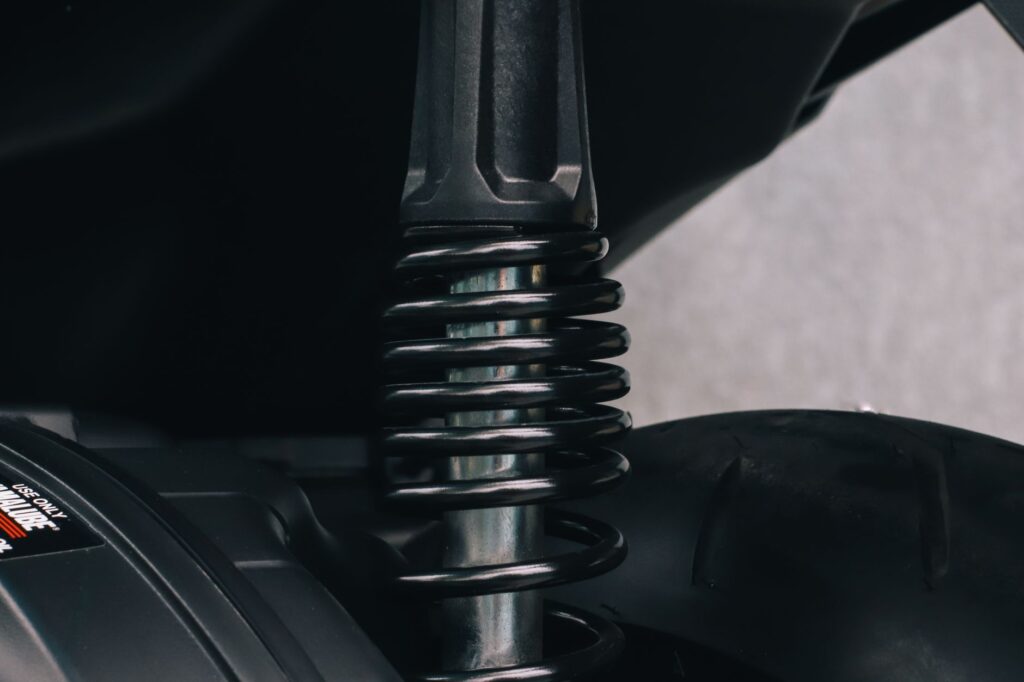
The spring and damping system determines how the vehicle responds to road inputs. Springs support the vehicle’s weight and define ride height, while dampers control oscillations and energy dissipation. Engineers select between coil springs, leaf springs, or torsion bars depending on application needs. Shock absorbers are tuned for compression and rebound characteristics to balance comfort and control. A well-designed suspension system ensures that after hitting a bump, the vehicle quickly stabilizes without excessive bouncing or harshness.
6. Elastokinematics Integration
Real-world suspension systems are not perfectly rigid, and compliance plays an important role in behavior under load. Elastokinematics accounts for deformation in bushings and joints, which can subtly alter wheel alignment during driving. These small changes affect tire contact patch behavior, steering precision, and stability. Engineers model these effects to refine handling characteristics and ensure consistent performance under both light and heavy loads. This step bridges the gap between ideal simulation and real-world behavior.
7. Prototyping and Testing
Once the virtual design is validated, physical prototypes are built and tested. These prototypes are installed on test vehicles and subjected to controlled conditions, including track testing, road simulations, and durability courses. Engineers collect data on vibration response, ride comfort, handling precision, and noise levels. Differences between simulation and real-world behavior are analyzed and used to refine the design. This iterative process is essential for validating assumptions made during the digital design phase.
8. Durability and Fatigue Testing
Suspension systems must endure millions of load cycles throughout their operational life. Fatigue testing simulates long-term usage by applying repeated stress cycles that replicate real driving conditions. Engineers assess potential failure points and ensure that materials and joints can withstand prolonged exposure to stress without degradation. This stage is critical for safety and reliability, as suspension failure can have severe consequences.
9. Tuning and Optimization
Even after successful prototyping, fine-tuning is required to achieve the desired driving characteristics. Engineers adjust spring rates, damper settings, and alignment parameters to refine handling and comfort. This phase often involves both objective data analysis and subjective driver feedback. In advanced systems, adaptive suspension technologies may be calibrated to adjust performance dynamically based on driving conditions.
10. Manufacturability and Cost Optimization
Before production, the design is optimized for manufacturability. Engineers collaborate with manufacturing teams to simplify component design, reduce part count, and select cost-effective materials without compromising performance. Assembly processes and tolerances are finalized to ensure consistency in mass production. The goal is to deliver a suspension system that meets performance requirements while remaining economically viable for large-scale production.
The suspension design process is a highly iterative and multidisciplinary engineering workflow that transforms performance goals into a functional mechanical system. It integrates geometry, material science, structural analysis, and real-world testing to achieve a balance between comfort, safety, durability, and cost. From initial requirements to final manufacturing optimization, each stage plays a crucial role in shaping how a vehicle interacts with the road and delivers its driving experience.